|
![]() |
|
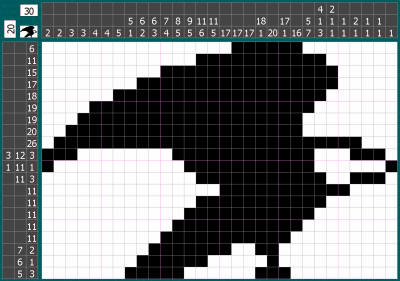
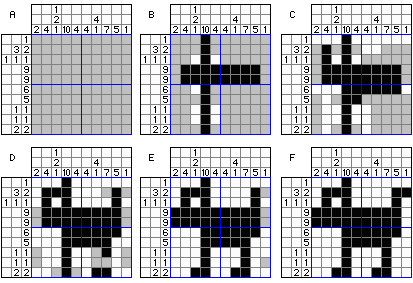
![]() To download the shareware version, click here. The current version is 2.0. The price of the licensed version is $19.95. LICENSED USERS: See the bottom of this section for additional puzzle sets Descartes Enigma is a game of logic and deduction, based upon the puzzle created in Japan by Tetsuya Nishio, and popularized in the United States by Games Magazine's World of Puzzles magazine as "Paint By Numbers." In the United Kingdom, the game is known as Nonograms. You're presented with a puzzle which conceals a hidden black & white picture, and you must discover the picture using the row and column clues which give you information about the locations of the black "pixels" in the picture. A sample puzzle-solving animation is available to show you the basic appearance of a SMALL puzzle: ![]() Below is a simple example of a puzzle from Descartes Enigma, showing the puzzle at six different stages from beginning to end. "A" is the beginning of the puzzle. This particular puzzle is a 10x10 array containing a hidden picture (which is revealed in "F" if you can't keep from looking). You're given clues for each row and column which tell you how many black squares there are in that row AS A GROUP. A group of black squares are squares that are contiguous within the row or column with NO white squares between them. If a white square is between two black squares, then those two black squares belong to different "groups." So, in this example, the first (topmost) row has ONE group and it contains ONE black square. The second row contains TWO groups, one of THREE squares and one of TWO squares. The third row contains THREE groups of ONE square each. The groups always appear in the proper sequence for the row or column. The only unknown is how much white space exists before, between, or after each group. (This explanation is continued below the diagram...) ![]() The first couple of deductions are quite easy. The 4th column has a group of 10 blacks, and since the puzzle is only 10 squares high, the entire column is black. The 4th and 5th rows each have a group of 9 blacks. There's only two ways to position 9 black squares within a row of 10 squares, and in both cases all but the end squares are black. (In other words, we know where 8 of the 9 black squares are, because those squares are black in all possible ways that the 9 squares can be positioned in the row.) Now, with those deductions made, we can determine a few squares that have to be white. Since the 3rd row has ONLY groups of 1's, the black square in the 4th column of the 3rd row must have at least one white square on each side (because if one of the other groups of 1 black squares were positioned right next to this one, then it would be a group of TWO rather than a group of ONE). The same thing applies to the 8th and 9th rows. Lastly, looking at the 3rd column, the two black squares can ONLY be the group of TWO, and so must have at least one white square both above and below. Now, moving on to figure C, the 1st row has only one group of one (which is already known), so ALL other squares in the first row MUST be white. The 6th row has a single group of 6, so the black square that's known in that row MUST be the beginning of the group of 6 (because it has a white square to its immediate left). So, we know where all 6 black squares are located, and all other squares in the row must be white. Similar logic then applies to the 2nd column, where we can locate all 4 black squares, and the rest must be white. Then, the three black squares in the 6th column are part of the single group of 4 blacks, so the fourth black must be either immediately above or immediately below that group, and so all OTHER squares in that column must be white. Similar logic applies to the 7th column, except here the additional group of 1 only allows us to turn one square white. Continue with this kind of logic and eventually the entire puzzle is, simply, black and white. The puzzles vary in size from 10x10 up to 75x45 (in steps of 5). There is a companion game, Descartes Rainbow, which presents multi-colored puzzles (see below). ADDITIONAL DESCARTES ENIGMA PUZZLE SETS NOTE: The shareware version of the Descartes Enigma will NOT load the following puzzle sets. They will only work with the licensed version of the game. So, if you have not yet purchased the licensed version, save yourself the trouble of downloading these files. The following files contain additional puzzles for the licensed version of Descartes Enigma 2.0. (This file will only work with version 2.0, not version 1.0. If you have version 1.0 and wish to use future puzzle sets that are posted to this page, you'll need to upgrade to version 2.0. Sorry about that...). Simply download and run them to install them in your DE "PUZZLES" folder (AFTER having installed the licensed 2.0 version of the game!) Then run the game, and select them from the Player-SelectPuzzleSet menu. The default install folder for Descartes Enigma is C:\EKS\DE. These files would then be installed in C:\EKS\DE\PUZZLES. If you changed the install folder during SETUP, then you will need to appropriately modify the install folder for these files to wherever you DID install Descartes Enigma. Many of these puzzles were created and sent to me by users. If you create any you'd like to contribute to this list, send me a copy by email or on disk, and I'll make them available for others to download and play. Also, if you create a color scheme that you think others might enjoy, send it to me and I'll add it to this page too. (See Player-Colors in the program for alternate color schemes, and read the Help screen for more information.) DE_EXTRA - All of the extra puzzle sets as a single compressed EXE file. (2.5 Mbytes - June 2, 2004) GRANTSTUFF
- 19 miscellaneous puzzles from Grant Fikes (June
2, 2004) ADDITIONAL DESCARTES ENIGMA COLOR CONFIGURATIONS The following files are additional COLOR configuration files for Descartes Enigma. To install and use them, download them, run them (installing to C:\EKS\DE, or wherever you installed the game... the self-extracting ZIP file includes the UI sub-folder as part of its path, which is where the file should end up, but YOU should specify C:\EKS\DE (or whatever) as the install to path). Then run the game, click on Player-Colors... and select the file. These selections affect the colors used for drawing the game display, including the background. GRANTWATER - A set from Grant <gbf87@cox.net>.
|